Last updated: 3 September, 2026
You check a box on a form, or someone asks about your beliefs at a dinner party, and you hesitate. “Religious” doesn’t quite fit. Neither does staying silent about the part of you that prays, meditates, or just feels something bigger watching over your life. So you land on the phrase a lot of people use now: “I’m spiritual but not religious.” But what does that actually mean, and is it just a dodge, or a real, distinct way of relating to the sacred?
Here’s the direct answer. Being spiritual means you believe in or seek connection to something greater than yourself, a higher power, energy, or purpose, and you pursue that connection through personal practice rather than a fixed institution. Being religious means you follow an organized system of beliefs, rituals, and community, usually with shared scripture, clergy, and doctrine. Spirituality is personal and flexible. Religion is structured and communal. Many people are both. Many are only one. Neither one is more valid than the other.
Below, I’ll walk through what actually separates the two, why so many people now describe themselves as spiritual but not religious, what each path offers that the other doesn’t always provide, and how to figure out where you personally land.
The Quick Answer: Spiritual vs Religious in One Breath
If you want the short version before we go deeper, here it is.
- Religion is a shared system: specific beliefs, sacred texts, rituals, and a community that practices together, usually under a name like Christianity, Islam, Buddhism, or Judaism.
- Spirituality is a personal search: a felt sense of connection to something larger than yourself, whether you call that God, the universe, source energy, or simply “more.”
- You can have one without the other. You can be deeply religious without feeling much personal spiritual connection, and you can be intensely spiritual without belonging to any organized faith at all.
None of this is a competition. Both paths have carried people through grief, joy, and everyday life for as long as humans have asked what any of this means.
Where the Two Actually Diverge
The clearest way to see the difference is to look at where the authority sits.
In religion, meaning comes from an external source. A text, a tradition, a religious leader, or a community’s shared interpretation tells you what’s true, how to worship, and what’s expected of you. There’s structure: services on a certain day, specific prayers, defined holidays, a hierarchy of teachers or clergy.
In spirituality, meaning comes from the inside out. You decide what resonates. Maybe that’s a morning meditation, a walk in the woods that feels like prayer, journaling, tarot, breathwork, or simply paying closer attention to your own intuition. There’s no attendance sheet and no single authority telling you you’re doing it “right.”
Neither approach is inherently deeper or more sincere than the other. A person sitting in a pew every Sunday can have a profound, personal relationship with the divine. A person who’s never set foot in a temple can feel a constant, grounded sense of connection to something bigger. The label doesn’t decide the depth.
Why “Spiritual But Not Religious” Became So Common
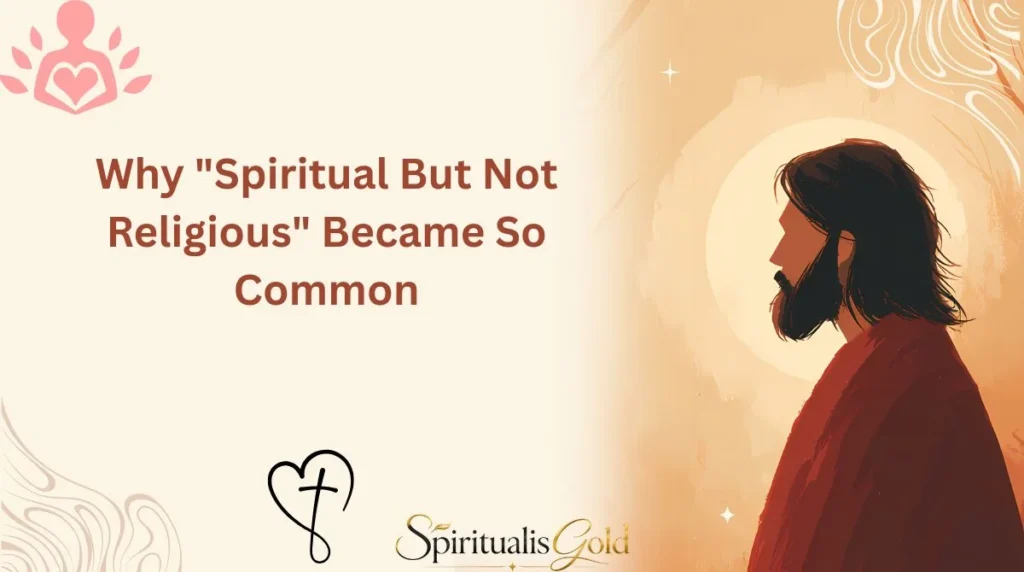
If you’ve noticed more people around you using this exact phrase, you’re not imagining it. Surveys on religious identity in the US have tracked a steady rise in people who say they have no formal religious affiliation, while still describing themselves as spiritual, praying, or believing in something beyond the physical world.
A few reasons come up again and again when people explain why they’ve moved this direction.
They want connection without the baggage. For many, “religious” carries associations with rigid rules, judgment, or institutional history they don’t want to inherit, even if they still crave a sense of the sacred.
They’ve had experiences institutions didn’t hold space for. A near-death experience, a strange synchronicity, a moment of overwhelming peace during a hard season. These moments often don’t map neatly onto a single doctrine, so people build their own framework instead.
They value personal experience over prescribed belief. Rather than being told what to believe, many people today want to test it against their own life first. Does this practice actually calm me? Does this idea actually hold up when things get hard? If yes, they keep it. If not, they let it go.
They pull from more than one tradition. A person might light a candle from their Catholic upbringing, meditate using a Buddhist technique, and check their horoscope, all in the same week, without feeling like they’re betraying any of it. Religion tends to ask for consistency within one system. Spirituality is comfortable with a patchwork.
What Religion Offers That Spirituality Sometimes Doesn’t
It’s worth being honest here, because a lot of writing on this topic quietly favors spirituality as the more “evolved” option. That’s not accurate, and it misses real strengths religion has.
Community and continuity. Religious institutions provide built-in community: people who show up for you at weddings, funerals, and hard seasons, often across generations. That kind of steady, structured support is harder to build alone.
A shared moral framework. Religion often gives clear, agreed-upon answers about right and wrong, which can be grounding, especially during a crisis when you don’t have the bandwidth to build your own ethical system from scratch.
History and depth. Established religions carry centuries, sometimes millennia, of accumulated wisdom, ritual, and interpretation. That depth isn’t something a solo spiritual practice can replicate quickly.
Accountability. Belonging to a religious community often means other people notice when you drift from your values, and gently or firmly call you back. A personal spiritual path can lack that outside check.
What Spirituality Offers That Religion Sometimes Doesn’t
The reverse is just as true. Spirituality has real strengths of its own.
Flexibility. You’re not locked into one interpretation. If a practice stops serving you, you can set it down without guilt or institutional consequence.
A direct, unmediated relationship. There’s no requirement to go through a specific leader or ritual to feel connected. Many people describe their spiritual practice as more intimate for exactly this reason.
Room for doubt. Spirituality generally has more tolerance for uncertainty. You can hold a belief loosely, question it, revise it, and still call your path spiritual. Some religious frameworks make less room for that kind of open-ended questioning.
Inclusivity across traditions. You’re free to draw from multiple wisdom traditions at once, taking what resonates from meditation, prayer, energy work, or nature-based practice, without needing to pick a single system and stay inside its lines.
Can You Be Both Spiritual and Religious?
Absolutely, and honestly, most religious people probably see themselves this way even if they don’t use the phrase. Being religious doesn’t mean your faith is only external ritual. Plenty of devout people describe a rich, personal, spiritual inner life that happens to be expressed through an organized tradition.
Think of it less as two separate boxes and more as two overlapping circles. Religion can be the structure a person’s spirituality lives inside. Spirituality can be the personal feeling that makes a religious ritual actually mean something, rather than just going through the motions.
The people who describe themselves as “spiritual but not religious” are usually saying something specific: they still want the personal connection, but they’ve stepped outside the structure. That’s a real, valid position, not a lesser one.
Signs You Lean More Spiritual
- You feel connected to something greater during quiet, personal moments rather than group services
- You’re drawn to practices like meditation, journaling, or time in nature more than scripture study
- You pull ideas from multiple traditions rather than committing to one
- You trust your own inner sense of what’s true over an outside authority telling you
- You’re comfortable holding uncertainty about the bigger questions
Signs You Lean More Religious
- You find meaning through shared ritual and community worship
- A specific text or teaching feels like a stable, trustworthy guide for your choices
- You value belonging to a tradition with clear history and continuity
- You want defined answers rather than an open-ended personal search
- Structure and consistency feel more comforting to you than flexibility
Most people land somewhere between these two lists, and that’s completely normal. This isn’t a personality test with a single correct result. It’s a spectrum, and where you sit on it can shift throughout your life.
How to Figure Out Where You Land
If you’re genuinely unsure which word fits you, or whether you need either label at all, a few honest questions can help.
- When do you feel most connected to something bigger than yourself? Is it during a service, a specific prayer, or a quiet private moment? Notice where the feeling actually shows up, not where you think it “should.”
- Do you want a community, or do you want privacy? Neither answer is wrong. Some people are recharged by shared ritual. Others feel most connected when no one else is watching.
- Do you want an authority to guide your beliefs, or do you want to build your own? There’s no shame in wanting guidance. There’s also no shame in wanting to test things yourself first.
- How do you handle uncertainty? If not knowing feels unbearable, a structured tradition might bring real relief. If open questions feel exciting rather than distressing, a personal spiritual path might suit you better.
- What actually calms you down on your hardest day? Whatever that is, prayer, scripture, meditation, a walk, a specific ritual, that’s a strong clue about where your real spiritual home is, regardless of what label you’d put on a form.
There’s no wrong answer here. Some people spend a lifetime moving between religious practice and independent spirituality, and that movement is part of the path, not a failure of it.
A Word on Respecting Both Paths
It’s easy, especially online, to see spirituality painted as the enlightened, open-minded choice and religion painted as outdated or closed off. That framing does a disservice to millions of people who find genuine depth, comfort, and moral grounding inside organized faith.
It’s just as easy to swing the other way and dismiss spirituality as vague or unserious compared to “real” religion. That’s unfair too. A private, unstructured connection to something greater can be every bit as sincere and life-changing as a formal religious practice.
Whichever word fits you, or if neither one quite does, the actual point isn’t the label. It’s whether your practice, whatever shape it takes, helps you live with more meaning, more compassion, and more peace than you’d have without it.
Spiritual vs Religious Reddit
Discussions about being spiritual versus religious on Reddit often reveal how personal these concepts can be. Some people describe religion as a structured path shaped by scripture, tradition, community, and shared practices, while spirituality is often described as a more personal search for meaning, connection, inner peace, or a relationship with the divine. These conversations can be thoughtful because people come from very different backgrounds.
At the same time, Reddit opinions should not be treated as the final definition of spirituality or religion. One person may find deep spiritual fulfillment inside an organized religion, while another may feel spiritually connected without belonging to any religious institution. The important distinction is that spirituality and religion can overlap, but they do not have to look identical for everyone.
10 Differences Between Religion and Spirituality
Religion and spirituality are closely related, yet they generally emphasize different aspects of a person’s inner and outer life. Religion commonly provides an organized framework, while spirituality tends to focus more strongly on personal experience and inner connection.
- Structure: Religion usually has established teachings, traditions, and practices, while spirituality can be more flexible and individually shaped.
- Community: Religion often emphasizes belonging to a faith community. Spirituality can be practiced privately without formal membership.
- Authority: Religious traditions may rely on sacred texts, teachers, or established institutions. Spirituality often gives greater importance to personal reflection and experience.
- Worship: Religion commonly includes defined forms of worship, prayer, rituals, or ceremonies. Spirituality may involve meditation, contemplation, nature, prayer, or quiet self-reflection.
- Beliefs: Religions generally have shared beliefs that help define the tradition. Spiritual beliefs can vary considerably from one individual to another.
- Tradition: Religion is often connected with generations of history and cultural practices. Spirituality may develop through personal experiences and changing perspectives.
- Identity: Religious identity may be connected to a particular faith or denomination. Spiritual identity can be broader and less formally defined.
- Purpose: Both can explore life’s purpose, but spirituality often approaches the question through personal discovery, while religion may provide teachings about life’s purpose.
- Rules: Religions may include ethical and moral guidelines for living. Spirituality may focus more on values such as compassion, awareness, authenticity, and personal growth.
- Experience: Religion can provide spiritual experiences through established practices and community. Spirituality often places strong emphasis on the individual’s direct experience of meaning, connection, or transcendence.
These differences are not absolute. Many religious people are deeply spiritual, and many spiritual people appreciate religious traditions.
Can You Be Spiritual and Religious?
Yes, a person can absolutely be both spiritual and religious. In fact, for many people, the two naturally belong together. Religion can provide a foundation of teachings, community, prayer, and tradition, while spirituality can describe the personal experience of living those beliefs with sincerity.
Someone might attend religious services, pray according to their tradition, study sacred texts, and participate in religious celebrations while also spending time in meditation, reflecting on life’s deeper meaning, and seeking a personal relationship with God.
The difference is often less about choosing one side and more about how a person experiences faith. Religion may give someone a spiritual framework, while spirituality gives that framework personal depth and emotional meaning.
Spiritual vs Agnostic
Spirituality and agnosticism describe different things, although they can sometimes exist together. Spirituality generally refers to a person’s search for meaning, connection, transcendence, or a deeper understanding of existence. Agnosticism, by contrast, is primarily a position of uncertainty about whether God or ultimate reality can be known.
An agnostic person may say, “I don’t know whether God exists.” A spiritual person may be more focused on questions such as, “What gives life meaning?” or “How can I feel connected to something greater than myself?”
A person can also be spiritual and agnostic. They may not claim certainty about God while remaining open to mystery, consciousness, nature, meditation, or experiences they consider meaningful. Spirituality does not always require absolute certainty, and agnosticism does not necessarily mean rejecting every spiritual possibility.
Spiritual and Religious Meaning
The phrase spiritual and religious generally describes a person whose life includes both personal spirituality and participation in a religious tradition. It can mean finding inner meaning while also following the teachings, practices, or community of a particular faith.
For example, someone may consider prayer more than a routine. They may experience it as a deeply personal conversation with God. Their religion provides the language and tradition, while their spirituality gives the practice personal significance.
This combination can be meaningful because it connects inner experience with a larger tradition. Rather than seeing religion and spirituality as opposites, many people experience religion as one of the ways through which their spirituality becomes expressed.
Spiritual and Religious Beliefs
Spiritual and religious beliefs can overlap in many ways, particularly when a person believes that life has a deeper purpose or that human existence is connected to something beyond the physical world. Religious beliefs often come from a specific tradition, scripture, theology, or community.
Spiritual beliefs can be more personal. Someone might believe in prayer, divine guidance, the importance of compassion, the interconnectedness of life, or the value of inner transformation without describing every belief through a formal religious system.
However, spirituality should not automatically be associated with one particular set of beliefs. Spiritual people can hold very different ideas about God, consciousness, the soul, nature, morality, and what happens after death.
What matters most is understanding that belief is deeply personal. Two people can use the word “spiritual” while meaning very different things, just as two religious people from different traditions may understand faith differently.
Spiritual vs Religious Examples
A simple example can make the distinction easier to understand.
Imagine two people who both believe in God. One regularly attends a place of worship, follows religious traditions, studies scripture, observes holy days, and participates in a faith community. Their faith is expressed strongly through an established religious tradition.
Another person may pray privately, spend time reflecting on God, meditate, seek meaning in nature, and focus on becoming more compassionate without regularly participating in organized religion.
The first example is primarily expressed through religion, while the second may be described as spirituality. Yet there is no reason the same person cannot do both.
Another example is forgiveness. A religious person may forgive because their faith teaches the importance of mercy and forgiveness. A spiritual person might approach forgiveness as a path toward inner freedom and emotional healing. Both may arrive at the same compassionate action through somewhat different frameworks.
Spiritual but Not Religious Example
A spiritual but not religious person may believe that life has a deeper dimension without identifying with a particular organized religion. For example, someone might meditate every morning, spend time in nature, practice gratitude, believe in a higher power, and regularly reflect on their purpose and values, but not attend religious services or follow the formal teachings of a specific faith.
Their spirituality may come from personal experiences rather than institutional tradition. They might say, “I believe there is something greater than myself, but I am still exploring what that means.”
Being spiritual but not religious does not necessarily mean being anti-religious. Many people respect religious traditions while choosing a personal spiritual path. For them, spirituality is less about belonging to an institution and more about discovering meaning, developing inner awareness, practicing compassion, and feeling connected to something greater.
Ultimately, the difference between spirituality and religion is not always a strict divide. For some people, religion is the foundation of their spirituality. For others, spirituality exists independently of religion. And for many, the two meet naturally in prayer, reflection, service, love, and the search for a meaningful life.
People also search
spiritual and religious person
spiritual vs religious reddit
10 differences of religion and spirituality
spiritual vs agnostic
can you be spiritual and religious
spiritual and religious beliefs
spiritual vs religious examples
spirituality vs religion quotes
Frequently Asked Questions
Can a person be spiritual but not religious?
Yes, a person can be deeply spiritual without following an organized religion. Spirituality can be a personal journey centered on inner peace, meaning, connection, consciousness, or a relationship with something greater than oneself.
Are Christians spiritual or religious?
Christians can be both spiritual and religious. Religion often provides beliefs, traditions, worship, and community, while spirituality describes the personal experience of faith, connection with God, prayer, and inner transformation.
What is the difference between organized religion and spirituality?
Organized religion usually follows established beliefs, practices, teachings, and communities, while spirituality tends to be more personal and inward. Religion may provide a structured path; spirituality often focuses on how deeply a person experiences and understands that path.
Was Jesus spiritual or religious?
Jesus can be understood as both spiritual and religious, because he lived within the Jewish religious tradition while emphasizing a profound inner relationship with God. His teachings focused strongly on love, compassion, faith, forgiveness, and transformation of the heart.
The Bottom Line
Spiritual vs religious isn’t really a debate with a winner. Religion offers structure, community, and continuity. Spirituality offers personal freedom and a direct sense of connection. Most people’s real beliefs sit somewhere between the two, shifting over time as life changes them. If you’re trying to find your own footing, start by noticing where you actually feel most connected, not where you think you’re supposed to, and let that honest answer guide the rest.

Riaz Ahmad is the author of SpiritualisGold.com, sharing meaningful spiritual lines, deep words, life lessons, and inspirational thoughts. With 6+ years of experience creating spiritual and reflective content, he aims to help readers find inner peace, wisdom, hope, and a deeper connection with life.