Last updated: 4 September 2026
You stop in front of a painting, a mandala, a carved figure, or even a piece of street art, and something in your chest shifts. You can’t explain it. It’s not the technique or the colors exactly. It’s like the piece is speaking to something underneath your everyday thoughts. Then you wonder: is that just good design, or is something more happening?
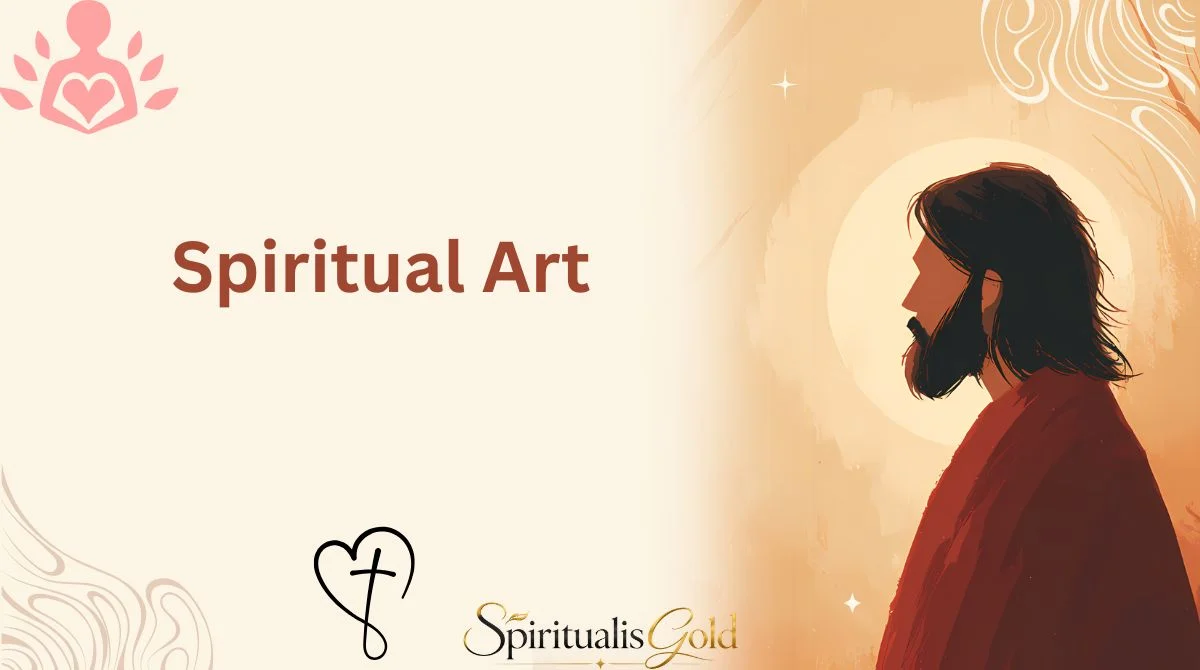
Here’s the direct answer. Spiritual art is any creative work made to express, awaken, or connect with something beyond the physical world, whether that’s the divine, the soul, a higher state of awareness, or a felt sense of unity with everything around you. It doesn’t have to be religious. It doesn’t need a temple wall or a church ceiling. A single line drawn with full presence can carry as much spiritual weight as a centuries-old icon, because the meaning comes from intention and resonance, not from format.
Below, I’ll walk through what makes art “spiritual” in the first place, the symbols and traditions that show up again and again across cultures, why certain pieces stop you in your tracks, and how to actually work with spiritual art in your own life instead of just admiring it from a distance.
What Makes Art “Spiritual” in the First Place
Not every beautiful painting is spiritual art, and not every spiritual piece is conventionally beautiful. The difference sits in intention and function, not just subject matter.
Spiritual art usually does one of three things:
- Points beyond itself. A mandala isn’t just a pattern. It’s built to represent wholeness or the universe in miniature.
- Holds a practice inside it. Icons in Eastern Orthodox tradition are painted (often called “written”) as an act of prayer, not just illustration.
- Opens a felt experience. Abstract or intuitive spiritual art doesn’t explain anything. It’s meant to be felt before it’s understood.
A landscape painting can be spiritual if it was made to capture a sense of awe at creation. A geometric pattern can be spiritual if it was designed to mirror the order some traditions believe underlies the universe. The label depends on what the piece is trying to do to the viewer, and to the maker.
Why Spiritual Art Moves People the Way It Does
There’s a real reason certain images grab you and others don’t, and it’s worth naming honestly before going further into symbolism.
Humans respond strongly to pattern, repetition, and symmetry. Mandalas, sacred geometry, and tiled religious motifs use exactly those elements, which is part of why they feel calming or hypnotic even to someone with no spiritual background at all.
Layered on top of that, many traditions believe art made with focused, reverent intention actually carries a kind of energy or presence. A piece painted during prayer, meditation, or ritual is thought to hold some of that state, and some viewers report picking up on it even without knowing the backstory.
Both explanations can be true at once. The pattern recognition is measurable. The energetic transmission is a matter of belief. Good spiritual art tends to work on both levels, which is exactly why it lands so differently than a piece made purely for decoration.
Common Symbols in Spiritual Art and What They Represent
A lot of spiritual art reuses the same handful of symbols across very different cultures. Knowing what they typically stand for makes it much easier to “read” a piece the next time you come across one.
The Mandala
The mandala, a Sanskrit word meaning “circle,” represents wholeness, the universe, and the self as a reflection of something larger. Found in Hindu and Buddhist art, mandalas are built from a center point outward, symbolizing a journey inward toward balance.
The Lotus Flower
The lotus grows up through muddy water and blooms clean above the surface. In Buddhist and Hindu art, it stands for purity emerging from struggle, and for spiritual awakening that isn’t erased by hardship but rises through it.
The Tree of Life
Found in Celtic, Kabbalistic, and Norse traditions, the Tree of Life represents connection between the physical and the divine, roots in the earth and branches reaching toward the heavens. It’s often used to show that all life is linked through one shared source.
Sacred Geometry
Patterns like the Flower of Life or the Sri Yantra are built on precise mathematical ratios. Practitioners of sacred geometry believe these shapes reflect the underlying order of creation itself, which is why the same geometric motifs appear independently across cultures that never had contact with each other.
The Eye
An eye, whether the Eye of Providence, the Eye of Horus, or the third eye depicted on a figure’s forehead, generally represents higher perception: seeing beyond the physical, spiritual insight, or divine watchfulness.
Halos and Light
Circles of light around a figure’s head, common in Christian, Buddhist, and Hindu art, mark that person as enlightened, blessed, or connected to a source beyond themselves. The light isn’t decorative. It’s meant to show inner radiance made visible.
Spiritual Art Across Traditions
Every major spiritual tradition has developed its own visual language, and seeing them side by side makes the shared threads easier to spot.
Christian iconography uses gold backgrounds, halos, and specific poses to represent holiness rather than realism. The goal historically wasn’t accuracy. It was to give the viewer a window into the sacred.
Buddhist thangka paintings, often made on cotton or silk, depict deities, mandalas, and the Wheel of Life in precise, symbolic detail. Monks traditionally treat the painting process itself as meditation.
Hindu deity art blends color, ornamentation, and multiple arms or heads to represent different powers and roles held by a single divine figure, not literal anatomy.
Islamic art largely avoids figurative depiction and instead channels spiritual expression through intricate geometric patterns and calligraphy, treating mathematical order and the written word as sacred in themselves.
Indigenous and Aboriginal art frequently encodes ancestral stories, land connection, and creation narratives directly into pattern and symbol, often carrying meaning that only certain community members are meant to fully interpret.
Celtic knotwork uses unbroken, interwoven lines to represent the eternal nature of life, faith, and connection, with no clear beginning or end.
None of these traditions are competing for the “correct” version of spiritual art. They’re separate visual languages built around the same underlying human impulse: to make the invisible visible.
Making Spiritual Art as a Personal Practice
You don’t need training, talent, or a religious background to use art spiritually. A lot of people find more meaning in the act of making it than in the finished piece.
A few approaches worth trying:
- Mandala drawing or coloring. Start from a center dot and build outward. The repetitive motion is often described as meditative in itself.
- Intuitive painting. Skip the plan. Let color and shape come out without deciding in advance what it should look like, then notice what shows up.
- Symbol journaling. Sketch a symbol that’s been on your mind, even roughly, and write down what it brings up for you before researching what it “officially” means.
- Altar or vision art. Combine images, words, and objects that represent what you’re working toward, treating the process of arranging them as a kind of prayer.
The point isn’t to produce something gallery-ready. A lot of practitioners describe the value as being in the focus itself, the same way a walking meditation isn’t really about the walking.
How to Read a Piece of Spiritual Art for Yourself
When you come across a piece that stops you, whether in a museum, on a wall in your own home, or scrolling online, a simple approach helps you get more out of it than a passing glance.
- Notice your first reaction before you analyze anything. Calm, unsettled, drawn in, resistant? That gut response usually says more than the symbolism alone.
- Look for a center point or focal symbol. Most spiritual art is built around one, and it usually holds the core message.
- Ask what the piece is doing, not just showing. Is it meant to calm you, humble you, wake you up, or comfort you?
- Sit with it for longer than feels natural. A few extra seconds of real attention often reveals detail a quick glance misses entirely.
- Let your interpretation stand even if it’s not textbook. Traditional meaning is a useful starting point, but your own response to a piece is real information too.
When It’s Just Aesthetic, and That’s Fine Too
Not every image with a mandala pattern or a lotus flower printed on it carries deep spiritual weight, and it’s worth saying that plainly. Mass-produced décor borrows spiritual symbols constantly, often stripped of the tradition or intention behind them.
That doesn’t make owning a pretty tapestry or a printed canvas wrong. It just means the piece is decorative rather than a genuine spiritual object, and it’s fine to enjoy it as exactly that. The meaning in spiritual art comes from intention, both the maker’s and the viewer’s, not from the presence of a recognizable symbol alone.
Famous Spiritual Art
Famous spiritual art has always given people a way to explore ideas that are difficult to express through ordinary words. Across different cultures and centuries, artists have created images representing divine presence, inner peace, enlightenment, sacred energy, the human soul, and the mystery of existence. Religious paintings, mandalas, symbolic figures, sacred geometry, mystical landscapes, and abstract energy paintings can all fall under the broader idea of spiritual art.
Some of the most recognizable spiritual artworks are connected with Christianity, Buddhism, Hinduism, and other ancient traditions. Michelangelo’s The Creation of Adam, for example, is often discussed for its powerful representation of the relationship between humanity and God. Buddhist thangka paintings use detailed imagery to represent teachings, meditation, and spiritual transformation. Hindu spiritual art frequently incorporates deities, lotus flowers, yantras, and cosmic symbolism.
What makes spiritual art famous is not simply its beauty. Its deeper appeal comes from the questions it creates. A viewer may look at an image and feel peace, wonder, connection, or even a sense of personal reflection. The meaning can also change depending on the viewer’s beliefs and life experiences.
Spiritual Art Drawing
Spiritual art drawing is a beautiful way to turn invisible thoughts and emotions into visible forms. Unlike traditional drawing, which may focus mainly on realistic objects, spiritual drawing often uses symbols, patterns, faces, nature, celestial elements, and abstract shapes to represent inner experiences.
A simple drawing of a lotus can symbolize growth because the flower rises from muddy water and opens beautifully above the surface. A tree can represent connection between earth and heaven, while a moon may suggest intuition, cycles, mystery, or inner reflection. Circles, stars, eyes, feathers, mountains, suns, and flowing lines are also commonly used to communicate spiritual ideas.
You do not need to be an expert artist to create meaningful spiritual art. Start with an emotion or idea you want to express, such as peace, healing, gratitude, transformation, or hope. Then choose symbols that personally represent that feeling. The finished drawing does not have to be perfect; its emotional meaning can be more important than technical skill.
Spiritual Art Meaning
The meaning of spiritual art depends heavily on symbolism, culture, personal beliefs, and the intention of the artist. One person may see a sunrise as a symbol of a new beginning, while another may interpret it as divine hope or the return of light after a difficult period.
Common spiritual symbols include the lotus for transformation, the tree of life for connection and growth, the circle for wholeness, wings for freedom, and the sun for light and vitality. Mandalas are often associated with balance, meditation, and the relationship between the inner and outer worlds.
Spiritual art does not necessarily have one fixed interpretation. Its purpose can be to encourage contemplation rather than provide a single answer. Sometimes the most meaningful artwork is the piece that makes you pause and ask yourself what you are feeling, searching for, or becoming.
Spiritual Art Yu-Gi-Oh
Spiritual art and Yu-Gi-Oh may seem like completely different subjects, but the connection becomes interesting when looking at symbolism, mythology, and supernatural imagery. The Yu-Gi-Oh universe contains Egyptian mythology, ancient symbols, mystical artifacts, gods, spirits, magical creatures, and themes surrounding destiny and hidden power.
Cards such as the Egyptian God cards use dramatic visual language inspired by ancient mythology. Their imagery demonstrates how popular entertainment can borrow ideas from spiritual traditions and transform them into fantasy storytelling.
It is important, however, to distinguish fictional spiritual imagery from actual religious or spiritual practice. Yu-Gi-Oh uses supernatural concepts as part of its fictional world. Fans may still appreciate these designs because of their symbolism, dramatic composition, ancient-inspired details, and mysterious atmosphere.
Spiritual Wall Art for Living Room
Spiritual wall art can give a living room a peaceful and reflective atmosphere without making the space feel overly religious. The best choice depends on the mood you want to create. Soft abstract artwork, moon phases, botanical designs, mandalas, celestial scenes, and minimalist spiritual symbols can work beautifully in modern interiors.
A large canvas featuring a peaceful mountain landscape can create a feeling of stillness and openness. For a warmer look, artwork featuring earthy tones, trees, sunlight, or natural textures can bring a sense of grounding into the room. If your living room has a minimalist design, simple line art with a lotus, sun, moon, or sacred geometric pattern may be more suitable.
Placement also matters. A large piece above the sofa can become the main focal point, while a collection of smaller prints can create a gallery wall. Choose artwork that complements your existing furniture and colors while still expressing something meaningful to you.
Spiritual Art Prints
Spiritual art prints are an accessible way to bring meaningful artwork into your home. Unlike original paintings, prints can be produced in different sizes and styles, making them suitable for bedrooms, meditation spaces, offices, entryways, or living rooms.
Popular choices include inspirational spiritual quotes, celestial illustrations, mandalas, sacred geometry, nature scenes, angels, lotus flowers, chakras, and abstract representations of energy. Some people prefer simple black-and-white line art, while others enjoy colorful artwork filled with symbolic details.
When choosing a spiritual art print, think beyond decoration. Ask yourself whether the image creates the feeling you want in the space. A peaceful print beside a meditation area may encourage calmness, while an uplifting quote near a workspace can serve as a daily reminder of strength and purpose.
Spiritual Art for Sale
Spiritual art for sale can range from inexpensive digital prints to handmade paintings, framed artwork, sculptures, and original pieces created by independent artists. Because the category is so broad, buyers have many opportunities to find artwork that fits both their personal taste and budget.
Before purchasing, consider the artwork’s size, material, framing, color palette, and intended location. An original painting may have unique textures and character, while a high-quality print can provide a similar visual effect at a lower cost.
The most valuable spiritual artwork is not necessarily the most expensive. A simple piece may become deeply meaningful because it reminds someone of a personal transformation, a loved one, a spiritual journey, or a moment of peace. When buying spiritual art, emotional connection can be just as important as monetary value.
Spiritual Painting Ideas
There are countless spiritual painting ideas for artists who want to create something meaningful. One approach is to combine nature with symbolism. A glowing sun rising behind mountains can represent hope, renewal, and a new chapter in life. A tree with roots extending into the earth and branches reaching toward the stars can symbolize grounding and spiritual growth.
Abstract spiritual paintings are another powerful option. Instead of painting a recognizable subject, you can use flowing shapes, circles, light, movement, and layered textures to represent emotions or energy. Blue and soft neutral tones may create a calm atmosphere, while brighter combinations can communicate joy, awakening, or transformation.
You can also create a celestial painting featuring the moon, stars, planets, and a human silhouette surrounded by light. Another idea is a lotus emerging from dark water, representing the ability to grow through difficult circumstances.
For something more personal, paint a visual representation of your own spiritual journey. Think about where you started, what challenges shaped you, and what kind of person you hope to become. Turn those experiences into colors, symbols, landscapes, and forms. The result does not need to follow any traditional definition of spiritual art. Sometimes the most powerful spiritual painting is simply an honest reflection of the artist’s inner world.
Ultimately, spiritual art is about more than beautiful images. It creates a meeting point between imagination, emotion, symbolism, and personal reflection. Whether you are choosing a print for your living room, drawing a meaningful symbol, or creating an original painting, the artwork can become a quiet reminder of what matters most to you.
What Is Spiritual Art?
Spiritual art is any creative work made with the intention of expressing, exploring, or awakening a connection to something beyond ordinary, physical reality, whether that’s the divine, the soul, a state of higher awareness, or simply a felt sense of belonging to something larger than yourself. It’s defined by purpose, not medium. A painting, a carving, a mandala, a photograph, and even a piece of digital art can all qualify, as long as the work is reaching toward that deeper connection rather than simply depicting a subject.
A few things generally set spiritual art apart from other creative work:
- It’s made with intention. The piece is created to represent or evoke something beyond the surface image, not just to depict a subject accurately.
- It doesn’t require a religious context. A piece can be spiritual without belonging to any organized faith, as long as it points toward meaning, connection, or transcendence.
- It works through symbol and feeling, not explanation. Spiritual art rarely spells out its message directly. It’s meant to be felt first and understood after.
This is different from religious art specifically, which is created for or within a particular faith tradition. Spiritual art is the broader category. Religious art sits inside it, but plenty of spiritual art carries no religious affiliation at all.
Frequently Asked Questions
What is the meaning of spiritual art?
Spiritual art is a creative expression of the inner world—faith, peace, mystery, healing, or connection with something greater than ourselves. It turns feelings that cannot easily be spoken into colors, symbols, shapes, and images.
What are the 7 spiritual levels?
The seven spiritual levels can be understood as stages of inner growth: awareness, awakening, self-discovery, healing, surrender, deeper connection, and spiritual wisdom. They represent a journey from simply living outwardly to understanding the deeper meaning of life within.
Is being artistic a gift from God?
Many people believe artistic ability is a gift from God because creativity allows us to bring something meaningful into the world that did not exist before. Whether expressed through painting, music, writing, or design, art can become a way of sharing beauty, emotion, and inspiration with others.
What is the spiritual meaning behind?
The spiritual meaning behind something is the deeper significance we discover beyond its ordinary appearance or purpose. It often invites us to look inward, reflect on our experiences, and understand what a symbol, moment, or feeling may be teaching us about ourselves and life.
The Bottom Line
Spiritual art earns its name through intention, not decoration. Whether it’s a centuries-old icon, a hand-drawn mandala, or a piece you made yourself with no plan at all, the meaning comes from what it’s reaching toward and what it stirs in you. Next time a piece stops you in your tracks, give it those extra few seconds of attention instead of walking past. That’s usually where the real message shows up.

Riaz Ahmad is the author of SpiritualisGold.com, sharing meaningful spiritual lines, deep words, life lessons, and inspirational thoughts. With 6+ years of experience creating spiritual and reflective content, he aims to help readers find inner peace, wisdom, hope, and a deeper connection with life.