Last updated: November 02, 2026
You’ve probably heard someone say, “I’m spiritual, not religious,” and wondered what that actually means. Or maybe you grew up in a faith tradition and now feel pulled toward something quieter and more personal, but you’re not sure if that still counts as spiritual, religious, or both.
Here’s the direct answer. Religion is a shared system of beliefs, texts, rituals, and community built around a specific tradition — think Christianity, Islam, Buddhism, or Judaism. Spirituality is the personal search for meaning, connection, and inner peace, and it doesn’t require belonging to any organized group at all. Religion tends to look outward, toward shared doctrine and structure. Spirituality tends to look inward, toward individual experience.
That’s the short version. The longer, more useful version is where the real clarity shows up, because most people’s lives don’t sit neatly on one side or the other. Below, I’ll walk through what each term actually means, where they overlap, where they pull apart, and how to figure out which words fit your own experience.
What Religion Actually Means
Religion is an organized framework. It usually comes with a few consistent features: a shared set of sacred texts, a defined belief system, rituals practiced in community, and often a leadership structure like clergy, priests, or imams who guide others in the tradition.
A few things tend to be true of most religions:
- Shared doctrine. Members generally agree on core beliefs, even if interpretation varies.
- Communal practice. Worship, prayer, or ritual often happens in groups, at set times, in defined spaces.
- Historical continuity. Religions carry traditions forward across generations, often for centuries.
- Institutional structure. There’s usually some form of leadership or hierarchy that maintains the tradition.
Religion gives people a map. It tells you what to believe, how to practice, and who else is walking the same road. For a lot of people, that structure is a comfort, not a limitation. Knowing exactly what Sunday service looks like, or what Ramadan requires, removes the guesswork from spiritual life.
What Spirituality Actually Means
Spirituality is harder to pin down because it’s deliberately less structured. At its core, spirituality is a personal relationship with something larger than yourself, whether you call that God, the universe, source energy, or simply “meaning.”
Spirituality often includes:
- Personal experience over shared doctrine. What feels true to you matters more than what a text or institution says.
- Flexible practice. Meditation, journaling, time in nature, or quiet reflection can all count.
- No fixed membership. You don’t need to join anything or follow a specific calendar of observances.
- Openness to multiple sources. Many spiritual people draw from several traditions rather than committing to one.
A lot of people who call themselves “spiritual but not religious” aren’t rejecting belief. They’re rejecting the idea that belief has to come packaged with a specific institution. They still want connection, meaning, and a sense that life has depth — they just want to find it on their own terms.
The Core Differences, Side by Side
| Religion | Spirituality | |
|---|---|---|
| Structure | Organized, institutional | Personal, flexible |
| Source of truth | Shared texts and doctrine | Individual experience |
| Community | Central and often required | Optional, sometimes solitary |
| Practice | Set rituals, specific times | Varies by person, no fixed schedule |
| Leadership | Clergy, priests, formal roles | Often self-guided |
| Goal | Salvation, adherence to teachings | Inner peace, personal growth, connection |
This table captures the general pattern, but real life rarely sorts itself into clean columns. Plenty of deeply religious people describe profound personal spiritual experiences inside their faith. Plenty of spiritual people borrow rituals, prayers, or texts from established religions without ever joining one.
Where the Two Actually Overlap
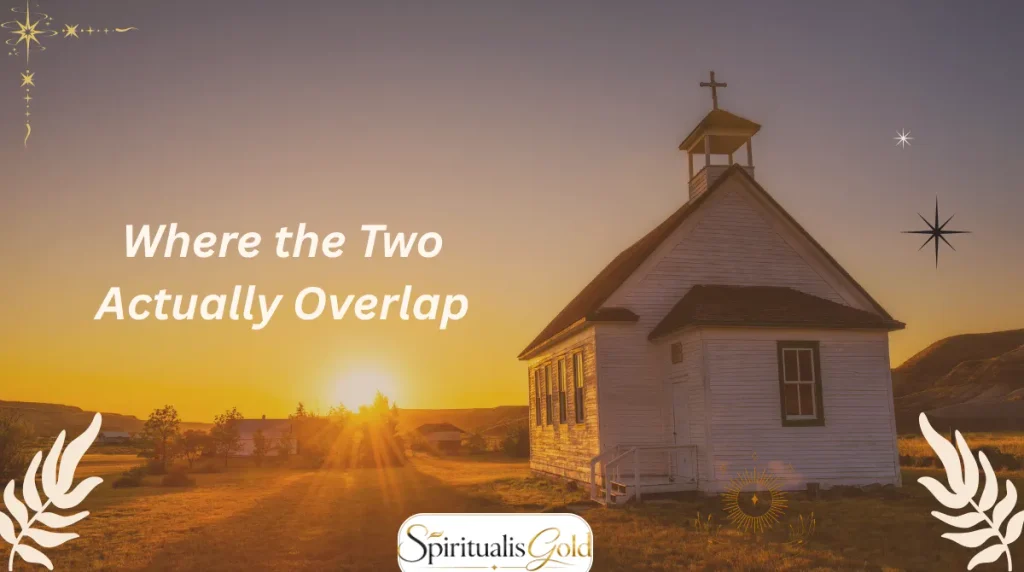
Religion and spirituality aren’t opposites. A better way to think about it: spirituality is often the inner experience, and religion is one possible outer container for that experience.
Someone can be religious and deeply spiritual at the same time. A person who prays daily within their faith tradition, feels genuinely moved during worship, and experiences real inner peace through that structure is both religious and spiritual. The institution hasn’t replaced the personal experience — it’s holding it.
On the flip side, someone can follow every rule of a religion without feeling any personal connection to it. Going through the motions of ritual without inner engagement is religious behavior without much spirituality attached. That’s part of why people sometimes draw a sharp line between the two words: they’ve seen or felt that gap firsthand.
4 Common Ways People Relate to Religion and Spirituality
Most people land in one of these four general patterns, though none of them are fixed for life.
1. Religious and Spiritual
This person belongs to a faith tradition and feels genuinely connected to it on a personal level. The rituals, texts, and community aren’t just obligations; they’re meaningful. Sunday service or daily prayer feels like real connection, not routine.
2. Religious but Not Especially Spiritual
This person follows a tradition out of habit, family expectation, or cultural identity, without necessarily feeling a strong personal or inner connection to it. They might attend services regularly but describe their inner experience as fairly detached.
3. Spiritual but Not Religious
This is the pattern that’s grown fastest in recent decades, especially among younger adults. This person seeks meaning and connection through personal practice, like meditation, nature, journaling, or quiet reflection, without committing to an organized religious tradition.
4. Neither Religious nor Spiritual
Some people don’t engage with either framework and find meaning through other means entirely, like relationships, work, or personal philosophy. That’s a valid path too, and it’s worth naming so this comparison doesn’t assume everyone fits into a spiritual-versus-religious box.
Why So Many People Are Choosing “Spiritual but Not Religious”
A lot of readers ask why this phrase has become so common. A few patterns come up again and again when people explain their own shift.
Distrust of institutions. Some people experienced hurt, exclusion, or rigid judgment inside organized religion and wanted to keep the meaning without the structure that caused the pain.
Desire for personal autonomy. Many people simply want to build their own practice instead of following someone else’s rulebook, picking what resonates and leaving the rest.
Access to multiple traditions. The internet made it easy to learn about Buddhist meditation, Christian contemplative prayer, and Indigenous practices all in the same afternoon, which naturally encourages a more mixed, personal approach.
A need for flexibility. Busy, nontraditional schedules don’t always fit neatly into weekly services or fixed observances, so people build practices that flex around their actual lives.
None of this means organized religion is declining in meaning for the people who still choose it. It simply means more people are finding that meaning can also exist outside institutional walls.
Can You Be Religious Without Being Spiritual, or Spiritual Without Being Religious?
Yes, in both directions. These two things are related but genuinely separate.
Someone can follow every religious practice required by their tradition and still describe their inner life as disconnected from it. That’s religion without much personal spiritual depth attached.
On the other side, someone can feel a profound, consistent connection to something greater than themselves through meditation, time outdoors, or quiet reflection, without ever stepping into a temple, church, or mosque. That’s spirituality without religion.
Neither version is more “correct” than the other. They’re different combinations of the same two ingredients: structure and inner experience.
How to Figure Out What Fits You
If you’re trying to work out where you land, a few honest questions tend to help more than any label does.
- Do you want shared structure, or do you want flexibility? Some people genuinely thrive with a set calendar of practice. Others feel boxed in by it.
- Does community matter to your practice, or is this a solitary thing for you? Both are valid; they just point in different directions.
- Are you drawn to one specific tradition, or do several traditions speak to you at once? That answer often reveals whether religion or a more personal spirituality fits better.
- What actually gives you a sense of peace or connection right now? Not what you were taught should give you peace. What genuinely does.
There’s no wrong answer here, and the answer doesn’t have to be permanent. People move between these categories throughout their lives, often more than once.
What Is the Difference Between Religion and Spirituality?
Religion and spirituality are closely connected, but they are not exactly the same. Both explore questions about life, purpose, faith, the soul, and the existence of something greater than ourselves. However, they approach these questions in different ways. Religion generally focuses on an organized system of beliefs, traditions, worship, and shared practices, while spirituality is often centered on personal experiences, inner growth, and an individual’s search for deeper meaning.
Religion usually connects people through a particular faith tradition. For example, Christianity, Islam, Hinduism, and Buddhism have established teachings, sacred texts, spiritual practices, and communities. Religious people may attend worship services, follow specific moral principles, celebrate holy days, and participate in traditional ceremonies.
Spirituality, on the other hand, can be a more personal journey. A spiritual person may seek a connection with God, explore the meaning of life, practice meditation, appreciate nature, or spend time understanding their inner thoughts and values. Some people follow a particular religion while developing their spirituality, whereas others consider themselves spiritual without belonging to an organized religion.
The important thing to understand is that religion and spirituality do not have to compete with each other. Religion can provide guidance and a sense of belonging, while spirituality can deepen a person’s understanding of faith and purpose. Both can help individuals explore their beliefs and develop a meaningful relationship with something greater than themselves.
Fundamental Differences Between Religion and Spirituality
Although religion and spirituality share several similarities, their approaches to faith, beliefs, and personal development can differ. Understanding these differences makes it easier to recognize how people experience their spiritual lives.
Personal Experience vs. Organized Tradition
Spirituality often develops through personal experiences, reflection, and an individual’s understanding of life. Religion generally involves established traditions, teachings, and organized practices shared by a community. A spiritual person may explore different ways of understanding the divine, while a religious person may follow the teachings of a particular faith.
Individual Journey vs. Community Worship
Spirituality can be practiced privately through prayer, meditation, self-reflection, or spending time in nature. Religion often encourages people to gather with others for worship, religious ceremonies, and community activities. However, both spiritual and religious experiences can be deeply personal.
Personal Exploration vs. Established Teachings
Spirituality often encourages individuals to explore questions about existence, consciousness, and purpose. Religion usually provides established answers through sacred scriptures, religious teachings, and traditions. This does not mean religious people cannot question or explore their beliefs.
Inner Connection vs. Religious Practices
Spirituality frequently emphasizes a person’s inner relationship with God, the universe, or a higher reality. Religion expresses faith through practices such as attending services, observing religious holidays, praying, fasting, and studying sacred texts.
Flexible Beliefs vs. Shared Belief Systems
Some spiritual individuals develop personal beliefs by exploring different philosophical or spiritual traditions. Religious communities generally share specific beliefs and teachings that help maintain their identity and traditions. Nevertheless, religious beliefs can also develop and be interpreted differently across cultures and generations.
Personal Meaning vs. Collective Identity
Spirituality often focuses on discovering personal meaning, purpose, and a sense of connection. Religion can provide a shared identity through common beliefs, history, worship, and community responsibilities. Both approaches can help people understand their place in the world.
These differences are general distinctions rather than strict rules. Many people experience religion and spirituality together, making the relationship between them more complex than a simple comparison.
Religion and Spirituality Examples in Everyday Life
Real-life examples make the difference between religion and spirituality easier to understand. Consider someone who regularly attends church, reads the Bible, participates in Christian celebrations, and follows the teachings of Jesus. These activities represent religious practices because they are connected to an established faith tradition.
Now imagine someone who spends time reflecting on life’s purpose, appreciates the beauty of nature, practices meditation, and seeks a deeper connection with God. These activities may represent personal spirituality, especially when they are not connected to a particular religious institution.
Another example is a Muslim who performs daily prayers, observes Ramadan, reads the Quran, and attends Friday prayers. These practices express religious commitment. The same person may also experience spirituality through sincere prayer, gratitude, compassion, and a personal awareness of Allah.
A person can also combine both approaches. For example, a Christian may attend church every Sunday while spending time in personal prayer, reflecting on Scripture, and seeking a deeper relationship with God. This individual is both religious and spiritual.
These examples show that religion is not limited to attending religious services, and spirituality is not limited to meditation or spending time alone. Both can influence how people understand themselves, treat others, and make decisions in everyday life.
What Does It Mean to Be a Spiritual and Religious Person?
A spiritual and religious person is someone who follows a particular faith tradition while also developing a personal connection with the beliefs and values behind it. Such an individual does not simply participate in religious activities but also tries to understand their deeper meaning.
For example, a Christian who attends church, reads the Bible, and participates in worship may also develop spirituality through personal prayer, forgiveness, gratitude, and a sincere relationship with God. Their religion provides a foundation, while their spirituality influences how they experience and practice their faith.
Similarly, a Muslim may follow Islamic teachings, perform daily prayers, observe fasting, and practice charity while seeking greater closeness to Allah through reflection, sincerity, and devotion.
Being both spiritual and religious means that faith is not simply something practiced in public. It also becomes part of a person’s thoughts, values, relationships, and everyday decisions.
However, being religious does not automatically mean someone has the same level of spiritual awareness as another person. Likewise, a spiritual person does not necessarily belong to a religious community. Every individual’s experience of faith is different.
Understanding Spiritual and Religious Beliefs
Spiritual and religious beliefs influence how people understand existence, morality, human relationships, and the purpose of life. Although these beliefs sometimes overlap, they can develop through different experiences and sources of guidance.
Religious beliefs are generally shaped by sacred scriptures, traditional teachings, religious leaders, and established faith communities. For example, Christians believe in Jesus Christ and the teachings of the Bible, while Muslims believe in Allah and follow the teachings of the Quran and Prophet Muhammad.
Spiritual beliefs can include faith in a higher power, the importance of inner transformation, the existence of the soul, and the search for a deeper purpose. Some individuals believe that spiritual growth comes through prayer and a relationship with God, while others explore spirituality through meditation, contemplation, or their connection with nature.
There are also people who hold both religious and spiritual beliefs. They may follow the teachings of their religion while personally exploring how those teachings influence their character and understanding of life.
It is important to respect these differences because people come from different backgrounds and have different ways of understanding faith. Neither a person’s religious identity nor their spiritual identity should be judged simply by how closely it resembles someone else’s experience.
What Do Scholarly Articles Say About Religion and Spirituality?
Academic researchers have studied religion and spirituality for many years, particularly their definitions, similarities, differences, and influence on human life. Their findings suggest that the distinction between these concepts is not always straightforward.
A 2020 critical literature review by Chitra G. Paul Victor and Judith V. Treschuk, published in the Journal of Holistic Nursing, examined how faith, religion, and spirituality are defined in academic literature. The researchers explained that spirituality is a broad and subjective concept that may involve connections with God, nature, other people, and the search for meaning. Religion, meanwhile, is more closely associated with established traditions, beliefs, and organized practices.
Another important academic study, Conceptualizing Religion and Spirituality: Points of Commonality, Points of Departure by Hill and colleagues, published in the Journal for the Theory of Social Behaviour in 2000, cautions against treating religion and spirituality as completely opposite concepts. The researchers emphasize that both have shared characteristics and meaningful differences.
Research published in the Journal for the Scientific Study of Religion in 2008 also explored how people understand these concepts. The study found that participants were more likely to associate religion with community affiliation, personal beliefs, and organized practices, while spirituality was often viewed as a broader and more abstract concept.
These scholarly discussions demonstrate that there is no single definition accepted by every researcher. Religion and spirituality can overlap, influence one another, and sometimes describe different aspects of the same person’s experience.
Spirituality vs Religion Quotes
Sometimes a short, meaningful statement can explain the relationship between religion and spirituality more clearly than a lengthy discussion. The following original reflections express different ways of understanding these concepts.
- “Religion can guide your path, while spirituality helps you understand the meaning behind the journey.”
- “Faith gives people something to believe in, while spiritual growth encourages them to live according to that belief.”
- “Religion connects people through shared traditions, while spirituality can connect the heart with a deeper purpose.”
- “You can follow a religious tradition and still discover new depths within your spiritual life.”
- “Spirituality is not always about finding answers; sometimes it begins with asking meaningful questions.”
- “True spiritual growth is reflected not only in what you believe but also in how you treat others.”
These reflections are not quotations from historical religious figures. They are original thoughts intended to encourage reflection and understanding.
Religion vs Spirituality: What People Say on Reddit
Online discussions, including conversations on Reddit, offer an interesting look at how ordinary people understand the difference between religion and spirituality. People often share personal experiences about faith, religious traditions, spiritual growth, and their relationships with God.
One common perspective is that religion provides structure, community, and established teachings, while spirituality allows individuals to explore their beliefs more personally. Some people appreciate having a religious community because it provides guidance and a sense of belonging. Others prefer a more individual approach because they want to explore life’s deeper questions without following a particular institution.
Another frequently discussed perspective is that religion and spirituality can work together. People who identify as both religious and spiritual often explain that religious teachings give them direction, while personal spiritual experiences help them develop a deeper understanding of their faith.
Some Reddit discussions also reveal disagreements about organized religion, personal freedom, and religious expectations. These conversations can help readers understand different viewpoints, but individual comments should not be treated as scholarly evidence or representative of everyone’s experiences.
Ultimately, the most useful lesson from these discussions is that people experience faith in different ways. One person’s spiritual journey may involve organized worship, while another person’s may involve private reflection and a personal search for meaning.
People Also Search
difference between religion and spirituality scholarly articles
religion and spirituality examples
spiritual and religious person
spiritual and religious beliefs
6 fundamental differences between religion and spirituality
spirituality vs religion quotes
spirituality vs religion reddit
religion vs spirituality article
Frequently Asked Questions
What Is the Main Difference Between Religion and Spirituality?
Religion is generally based on organized beliefs, sacred teachings, traditions, and shared practices that guide people toward faith and worship. Spirituality, however, focuses more on personal growth, inner peace, self-discovery, and finding a deeper meaning in life. While religion often provides a structured path, spirituality allows people to explore their beliefs through personal experiences.
What Are 10 Key Differences Between Religion and Spirituality?
Religion and spirituality may share similar values, but they approach faith and personal growth in different ways. Here are ten important distinctions:
- Structure: Religion usually follows organized teachings and established traditions, while spirituality allows more personal freedom.
- Beliefs: Religion often has defined doctrines, whereas spirituality encourages individual exploration and understanding.
- Community: Religion commonly brings people together through congregations and shared worship. Spirituality can be practiced individually or with others.
- Worship: Religious people may participate in formal services, prayers, and rituals, while spiritual people may connect through meditation, reflection, or nature.
- Guidance: Religion often looks to sacred scriptures and religious leaders, while spirituality may draw guidance from personal experiences and inner reflection.
- Purpose: Religion often teaches people how to live according to their faith, while spirituality explores life’s deeper purpose and meaning.
- Practices: Religion may involve specific ceremonies and traditions, whereas spiritual practices can vary from person to person.
- Authority: Religious traditions generally recognize established spiritual authorities, while spirituality often emphasizes personal understanding and responsibility.
- Connection: Religion often emphasizes a relationship with God or a higher power, while spirituality may explore a connection with the divine, humanity, nature, or the universe.
- Approach to growth: Religion often encourages growth through faith and religious teachings, while spirituality emphasizes self-awareness, compassion, and inner transformation.
Neither approach is automatically better than the other. Both can encourage kindness, purpose, wisdom, and a more meaningful way of living.
What Are the Four Types of Spirituality?
Spirituality can take different forms depending on a person’s beliefs, experiences, and understanding of life. Four commonly discussed approaches include religious spirituality, mystical spirituality, humanistic spirituality, and nature-based spirituality. Religious spirituality focuses on a relationship with God, mystical spirituality explores deeper experiences of the divine, humanistic spirituality emphasizes love and human connection, and nature-based spirituality finds meaning through the natural world. These categories are ways of understanding spirituality rather than a universally accepted classification.
What Is the Difference Between a Religious and a Spiritual Person?
A religious person generally follows an established faith, participates in its traditions, and finds guidance through sacred teachings and religious communities. A spiritual person may focus more on personal beliefs, inner peace, self-awareness, and a deeper connection with life. However, these identities are not opposites. Someone can be deeply religious and equally spiritual when their faith is reflected in their compassion, character, and everyday actions.
Can a Person Be Spiritual but Not Religious?
Yes, a person can absolutely be spiritual without following an organized religion. Such individuals may believe in a higher power, value personal growth, practice meditation, or seek meaning through nature and human relationships without belonging to a particular religious tradition. Their spiritual journey is often guided by personal experiences, reflection, and individual beliefs rather than formal doctrines. Being spiritual but not religious does not necessarily mean rejecting God or faith; it simply means choosing a more personal approach to spirituality.
Is Spirituality Linked to God?
Spirituality can be closely connected to God, but the relationship depends on an individual’s beliefs and worldview. For many religious people, spirituality means developing a deeper relationship with God through prayer, faith, worship, and living according to divine teachings. Others understand spirituality as a connection with a higher power, universal energy, nature, or the deeper meaning of existence. Ultimately, spirituality does not have one universal definition, and a person’s connection with God is shaped by their faith, experiences, and understanding of the divine.
Final Thought
Most people’s relationship with meaning doesn’t fit neatly into one box, and it doesn’t need to. Religion and spirituality aren’t rivals; they’re two different ways people have always tried to make sense of something bigger than themselves. Whether you find that through a weekly service, a quiet morning walk, or both, the label matters less than whether the practice actually brings you peace. Take a moment this week to notice what genuinely feels meaningful to you, without worrying about which word it technically belongs to.

Riaz Ahmad is the author of SpiritualisGold.com, sharing meaningful spiritual lines, deep words, life lessons, and inspirational thoughts. With 6+ years of experience creating spiritual and reflective content, he aims to help readers find inner peace, wisdom, hope, and a deeper connection with life.