Last updated: October 9, 2026
You’ve felt it before you could name it. That heavy, static-y feeling of being pulled in ten directions at once, answering messages before you’ve finished your coffee, scrolling instead of sleeping. Then someone mentions a retreat, a few days away from all of it, and something in your chest loosens just at the thought.
Here’s the direct answer. A spiritual retreat is a set-apart period of time, away from your normal routine, meant to slow you down enough to reconnect with something bigger than your to-do list: your inner life, a higher power, your own intuition, or simply the parts of yourself that get buried under daily noise. Every tradition frames it a little differently, but the core meaning stays the same. A retreat is a deliberate pause that makes room for insight, healing, or guidance that day-to-day life rarely leaves space for.
Below, I’ll walk through what a retreat actually means on a spiritual level, how different traditions understand that meaning, the different forms retreats take, and how to tell if you’re actually ready for one instead of just burned out and craving a hotel bed.
The Quick Answer: What a Spiritual Retreat Really Means
If you only read one section, make it this one. Spiritually, a retreat represents three things at once.
- A reset. Stepping away from noise so your mind and spirit can settle.
- A listening posture. Creating quiet on purpose so you can hear something you normally talk over: your gut, your conscience, or a sense of guidance.
- A threshold. Many people leave a retreat with a decision made, a burden set down, or a new sense of direction they didn’t have when they arrived.
None of this requires a specific religion. Retreats show up in Buddhist monasteries, Christian retreat centers, Sufi communities, yoga ashrams, and completely secular mindfulness programs. The container changes. The underlying purpose, making space to hear what’s usually drowned out, stays remarkably consistent.
Why the Pull Toward Retreats Feels So Strong Right Now
A lot of readers tell me the urge to go on a retreat doesn’t creep up slowly. It arrives all at once, usually after a stretch of exhaustion, grief, a big life change, or a quiet sense that something is off even though nothing is technically wrong.
That timing isn’t a coincidence. Most spiritual traditions agree that clarity rarely shows up in the middle of chaos. It shows up in the gaps, the pauses, the moments when you finally stop moving long enough to notice what you actually feel. A retreat manufactures that gap on purpose, instead of waiting for burnout to force it on you.
Six Spiritual Meanings Behind Going on a Retreat
Here are the meanings that come up most often, whether the retreat in question involves a chapel, a meditation cushion, or a tent in the woods.
1. A Reset for an Overloaded Nervous System and Spirit
At its simplest, a retreat is a reset button. You remove the inputs, notifications, small talk, decisions, and give your inner world room to settle back into itself.
Many people describe the first day of a retreat as uncomfortable, almost itchy, because their system is so used to constant stimulation. By day two or three, that itch usually fades into something closer to stillness. That shift is often the whole point.
2. Distance as a Doorway
Physical distance from your normal environment tends to create emotional and spiritual distance too. Leaving your house, your usual routines, and your usual role (parent, employee, caretaker) makes room to ask questions you don’t normally have time for: Who am I outside of these roles? What do I actually want?
This is one reason retreats are so often held somewhere remote. The unfamiliar setting supports the inner shift, not just the scenery.
3. Silence as a Way of Listening
Almost every spiritual tradition treats silence as sacred, not empty. In Christian retreats, silence is meant to make room for prayer and God’s voice. In Buddhist retreats, silence supports insight and awareness. Inside modern mindfulness retreats, silence simply gives the mind a chance to settle enough to notice its own patterns.
Whatever the label, the meaning is the same. Quiet isn’t the absence of something. It’s the condition that lets something quieter than noise finally be heard.
4. A Symbolic Death and Rebirth
This shows up more than people expect, even outside explicitly religious retreats. You step away from your normal identity for a few days, sit with discomfort, boredom, or grief you’ve been avoiding, and come back changed in some small but real way.
Many participants describe leaving a retreat feeling like they set something down: a grudge, an old version of themselves, a belief that no longer fits. That’s the death-and-rebirth pattern in miniature. Nothing dramatic has to happen for it to count.
5. Community as a Mirror
Not every retreat is silent or solitary. Group retreats, whether a church retreat, a yoga intensive, or a grief retreat, add a different layer of meaning: other people reflecting your own experience back to you.
Hearing someone else describe a struggle you thought was uniquely yours can be its own kind of spiritual relief. You realize you’re not the only one carrying it, which often loosens the grip it has on you.
6. Preparation for a Decision
Retreats frequently show up right before a major life decision: a career change, a move, a relationship choice, or a spiritual commitment like baptism, ordination, or a vow. The retreat isn’t usually where the decision gets made from scratch. It’s where the noise clears enough for a decision that was already forming to become clear.
If you’re staring down a choice and feel like you can’t think straight surrounded by your normal life, that’s often a sign a retreat, or even a scaled-down version of one, could help.
How Different Traditions Understand the Retreat
The word “retreat” gets used across very different belief systems, and it’s worth knowing how the meaning shifts.
Buddhist retreats treat withdrawal from daily life as a way to sharpen concentration and insight. The tradition traces back to the Vassa, a rainy-season retreat established during the Buddha’s lifetime, and meditation retreats today, silent or guided, still center on developing awareness rather than escaping the world.
Christian retreats are usually built around prayer, scripture, and a deliberate return to relationship with God. The modern retreat format used by many Catholic and Protestant groups traces back to St. Ignatius of Loyola’s Spiritual Exercises in the 1500s, and the emphasis tends to fall on self-examination and renewed faith rather than physical rest.
Sufi retreats, rooted in the mystical branch of Islam, emphasize an inward journey toward divine closeness, often through solitude, remembrance practices, and guided reflection with a teacher.
Yogic and Hindu-influenced retreats frame the retreat as a chance to quiet the mind and body together, often combining physical practice with meditation, chanting, or study, on the belief that stillness in the body supports stillness in the spirit.
Secular mindfulness retreats strip away the religious framing but keep the same bones: silence, structure, and intentional distance from daily distraction, used to build self-awareness rather than connect with a specific deity or doctrine.
None of these traditions are competing for the “correct” definition. They’re different doors into the same basic experience: stepping back far enough to see your life more clearly.
Common Types of Retreats and What Each One Emphasizes
If you’re considering one, it helps to know the landscape isn’t one-size-fits-all.
- Silent meditation retreats – built around little to no talking, often multiple hours of sitting meditation a day.
- Church or faith-based retreats – structured around prayer, worship, and community teaching.
- Yoga retreats – combine movement, breathwork, and meditation, often in a wellness-resort setting.
- Wilderness or nature retreats – use isolation in a natural setting rather than a formal program to create space for reflection.
- Grief or life-transition retreats – designed specifically around processing loss or major change with guided support.
- Journaling and reflection retreats – lighter-structure retreats focused on writing, self-inquiry, and quiet time rather than a set spiritual practice.
None of these is more spiritually valid than another. The right type depends on what you’re actually seeking rest from and what kind of structure helps you settle rather than spiral.
Signs You Might Actually Be Ready for a Retreat
Not every craving for a break is a spiritual pull. Sometimes it’s just exhaustion, and that’s worth naming honestly. That said, a few signs tend to point toward something deeper than a standard vacation would fix.
- You feel disconnected from yourself, not just tired
- A specific question or decision keeps circling in your mind without resolution
- You notice you haven’t sat in real silence, without a screen, in longer than you can remember
- Something in you keeps whispering that you need to “go somewhere and think”
- You feel spiritually flat, going through motions of prayer or practice without feeling anything
If two or three of these sound familiar, a retreat is likely to offer more than a beach trip would, even a short one.
What Actually Happens on a Retreat
The details vary widely, but most retreats share a basic shape.
- Arrival and settling in. The first hours are often the hardest, as your mind adjusts to less stimulation.
- A daily rhythm. Meals, quiet time, guided sessions (meditation, prayer, journaling, or group discussion), and rest are usually built around a consistent schedule.
- A stretch of real discomfort. Boredom, restlessness, or emotion that’s been buried tends to surface once distractions are removed. This part is uncomfortable but often the most valuable.
- A shift. Somewhere in the middle to later part of most retreats, participants describe a noticeable settling, a sense of clarity or peace that wasn’t there on day one.
- Departure and integration. The final part usually includes some reflection on what to carry home, which matters more than people expect.
“Isn’t This Just a Vacation With Candles?”
It’s a fair question, and worth answering honestly instead of dismissing it. A vacation is generally built around comfort, novelty, and escape from responsibility. A retreat is built around the opposite: reduced stimulation, structure, and often deliberate discomfort in service of insight.
You can absolutely rest on a retreat. But the purpose isn’t relaxation for its own sake. It’s using stillness as a tool to reconnect with something you’ve lost touch with, whether that’s your faith, your intuition, your body, or simply your own thoughts without a screen competing for attention.
How to Choose a Retreat That Actually Fits You
- Get honest about what you’re seeking distance from. Noise, a decision, grief, spiritual dryness, and burnout all call for slightly different formats.
- Match the structure to your personality. If total silence sounds unbearable rather than restful, a group or guided retreat may serve you better than a solo silent one.
- Check the length before the location. A weekend is enough to start settling. A full week allows for deeper shifts, but only if your schedule and nervous system can handle it.
- Ask what happens after. Retreats with some kind of follow-up, a journal prompt, a community, a mentor, tend to help the insight stick rather than fade by Monday.
Bringing the Retreat Home
This is the part most retreat guides skip, and it matters more than the retreat itself. Whatever clarity, peace, or decision showed up while you were away has to survive contact with your regular life, which is harder than it sounds.
A few things genuinely help:
- Write down the one or two insights that felt most true before you forget them
- Choose one small, concrete change to make in the first week home, rather than trying to overhaul everything at once
- Protect a slice of the quiet you built, even ten minutes a day, so the whole thing doesn’t evaporate by the second week
The retreat creates the clarity. What you do in the weeks after is what actually makes it mean something.
Purpose of Spiritual Retreat
A spiritual retreat is a meaningful opportunity to step away from the noise, pressure, and constant responsibilities of everyday life and create space for reflection, prayer, and inner renewal. The purpose is not simply to escape from daily responsibilities, but to return to them with greater clarity, peace, and a stronger sense of purpose.
For many people, a retreat provides time to examine the direction of their life. In a quiet environment, it becomes easier to ask important questions: Am I living according to my values? What is God calling me toward? Which habits are helping me grow, and which ones are keeping me spiritually distant? These questions can bring a deeper awareness that is sometimes difficult to experience during a busy routine.
Another important purpose is spiritual restoration. Just as the body becomes tired after continuous activity, the inner life can also become exhausted. Prayer, silence, Scripture, meditation, and peaceful surroundings can help a person reconnect with what truly matters. A retreat can also encourage forgiveness, gratitude, humility, and renewed trust in God.
Spiritual retreats are not reserved for people experiencing a crisis. They can benefit anyone who wants to deepen their faith, strengthen their relationship with God, or simply slow down and listen more carefully to the voice of conscience and faith.
What Is a Spiritual Retreat Catholic?
In the Catholic tradition, a spiritual retreat is a dedicated period of prayer, silence, reflection, and spiritual direction intended to help a person deepen their relationship with God. A retreat may take place in a monastery, retreat center, parish setting, or another peaceful environment away from ordinary distractions.
Catholic retreats can have different forms and purposes. Some focus on preparing for important moments such as Confirmation, marriage, ordination, or religious vocation. Others are designed for personal renewal and may include Mass, Eucharistic adoration, Confession, Scripture reading, meditation, and spiritual direction.
One central feature of a Catholic retreat is intentional attention to God. Instead of rushing through prayers or religious practices, participants are encouraged to become more present and receptive. Silence can be particularly important because it creates an environment in which a person can honestly reflect on their relationship with God and recognize areas where spiritual growth is needed.
The retreat is therefore more than a peaceful holiday. It is a period of intentional spiritual formation. The goal is to return to ordinary life with a renewed heart, greater faith, and a clearer commitment to Christian living.
Spiritual Retreat Bible Verses
The Bible contains many passages that reflect the heart of a spiritual retreat: becoming quiet, seeking God, renewing the mind, and finding strength in His presence.
One well-known passage is Psalm 46:10: “Be still, and know that I am God.” This verse beautifully captures the importance of slowing down. A retreat creates an environment where stillness is not something to avoid but something to embrace.
Mark 6:31 also offers an important principle. Jesus invited His disciples to come away with Him and rest for a while. The passage reminds Christians that rest and spiritual renewal have a legitimate place in a faithful life.
Romans 12:2 speaks about the transformation that comes through the renewal of the mind. A retreat can provide the time needed to examine thoughts, attitudes, priorities, and choices with greater honesty.
Matthew 11:28 offers another comforting invitation: “Come to me, all you who are weary and burdened, and I will give you rest.” For someone carrying emotional or spiritual burdens, a retreat can become a time of bringing those concerns honestly before God.
These verses show that retreat is not simply a modern religious practice. The biblical themes of solitude, rest, prayer, reflection, and drawing closer to God are deeply rooted in Christian faith.
Spiritual Retreat Meaning
The meaning of a spiritual retreat goes deeper than physically leaving one’s normal surroundings. At its heart, a retreat means intentionally creating distance from distractions so that the soul can become attentive again.
Modern life often leaves little room for silence. Phones, work, social responsibilities, entertainment, and constant information can make it difficult to hear one’s own thoughts, let alone spend meaningful time in prayer. A retreat interrupts that pattern.
Spiritually, retreat can mean returning to the essentials: faith, conscience, relationships, gratitude, forgiveness, purpose, and one’s relationship with God. It provides an opportunity to look inward without becoming self-absorbed. The purpose of reflection is ultimately transformation.
A person may leave a retreat without having every question answered. Yet they may have something equally valuable: greater peace about what needs to happen next. Sometimes spiritual growth does not come through discovering a dramatic revelation. It comes through becoming quiet enough to recognize what has been present in the heart all along.
Spiritual Retreat Activities
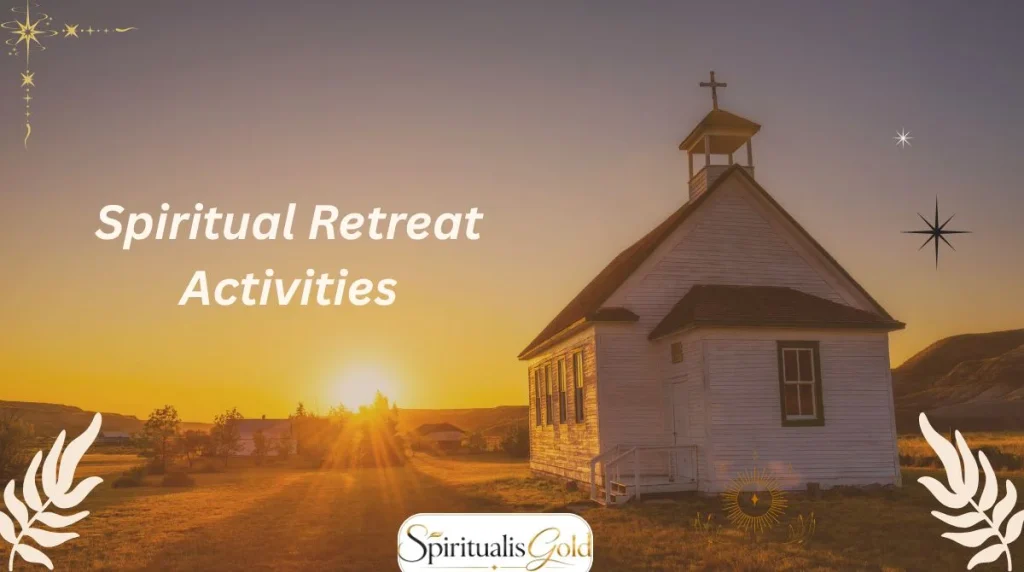
Spiritual retreat activities can vary according to the tradition, location, and purpose of the retreat. The most valuable activities are usually those that encourage genuine reflection rather than simply filling every moment with tasks.
Prayer is often at the center of a retreat. Participants may spend time in personal prayer, guided prayer, group prayer, or contemplative prayer.
Bible reading and meditation can help participants reflect deeply on Scripture rather than simply reading it quickly. A single passage may be considered throughout the day, allowing its meaning to develop gradually.
Silence is another powerful activity. Spending time without unnecessary conversation gives the mind an opportunity to settle and creates room for deeper reflection.
Journaling allows participants to write about their thoughts, questions, prayers, gratitude, struggles, and spiritual insights. Writing can make internal experiences easier to understand.
Worship and communal fellowship may include church services, singing, Eucharistic celebration, or group discussions. These activities remind participants that spirituality can be both personal and communal.
Other activities can include walking in nature, meditation, spiritual reading, confession, spiritual direction, acts of service, gratitude exercises, and periods of personal reflection. The purpose is not to complete a long list of activities but to create meaningful space for spiritual growth.
Spiritual Retreat Synonym
There are several words and phrases that can communicate a similar idea to spiritual retreat, although each carries a slightly different emphasis. Common alternatives include spiritual renewal, religious retreat, faith retreat, prayer retreat, silent retreat, spiritual getaway, time of reflection, period of solitude, and spiritual renewal experience.
In Christian contexts, terms such as day of recollection and retreat experience may also be used. A “day of recollection” generally emphasizes stepping away from ordinary activities for prayer and reflection, while a retreat may last from several hours to several days or even longer.
The best synonym depends on the context. If the emphasis is prayer, “prayer retreat” may be appropriate. If silence is central, “silent retreat” communicates the idea more clearly. When the focus is restoration and renewed faith, “spiritual renewal” may be the most natural expression.
Importance of Retreat in the Church
Retreats have an important place in the life of the church because they provide something that regular weekly worship may not always allow: extended time for personal reflection and spiritual formation.
Church services bring believers together for worship, teaching, fellowship, and encouragement. A retreat can complement these experiences by giving individuals more uninterrupted time to examine their own spiritual lives. It can help people move beyond simply hearing about faith toward consciously considering how faith shapes their decisions, relationships, attitudes, and daily behavior.
Retreats can also strengthen the church community. When people step away from routine together, they often develop deeper relationships and become more willing to share experiences, struggles, and hopes. This can create greater compassion and understanding within the congregation.
For church leaders and ministry workers, retreats can provide an opportunity to rest and reconsider their calling. Continuous service without meaningful renewal can lead to exhaustion. A retreat can remind them why they began serving and help restore the spiritual foundation behind their work.
Ultimately, the importance of a church retreat is not measured by how impressive the event is. Its value is found in whether people return with greater faith, humility, love, wisdom, and willingness to live out their beliefs.
Spiritual Retreat Christian
A Christian spiritual retreat is a deliberate period set aside to seek God through prayer, Scripture, silence, worship, reflection, and spiritual fellowship. Although Christian traditions differ in how retreats are organized, the central purpose remains similar: creating intentional space to deepen faith and renew one’s relationship with God.
Jesus Himself frequently withdrew from crowds to pray. This pattern offers an important lesson for Christians living in a world filled with constant activity. Solitude does not necessarily mean abandoning people or responsibilities. Instead, it can provide the strength and perspective needed to return to them with a healthier heart.
A Christian retreat may focus on repentance, forgiveness, spiritual growth, discovering one’s calling, overcoming discouragement, strengthening prayer, or simply resting in God’s presence. Some retreats are highly structured, while others allow participants considerable freedom to pray, walk, read Scripture, and reflect.
The deepest benefit of a Christian retreat is often what happens after it ends. A meaningful retreat should not become an isolated spiritual experience that quickly disappears when normal life resumes. Its lessons can become practical changes: making more time for prayer, treating others with greater patience, letting go of unnecessary resentment, reading Scripture more intentionally, or trusting God during uncertainty.
In this sense, a spiritual retreat is not an escape from real life. It is a pause that can help a person return to real life with renewed faith, clearer priorities, and a more peaceful heart.
Frequently Asked Questions
What does it mean to go on a spiritual retreat?
Going on a spiritual retreat means stepping away from everyday noise and responsibilities to create space for prayer, reflection, meditation, and inner renewal. It is a time to slow down, reconnect with your values, and seek deeper clarity about your relationship with yourself and God.
What does the Bible say about spiritual retreat?
The Bible shows that withdrawing from the busyness of life can be valuable for prayer and spiritual renewal. Jesus often went to quiet places to pray, reminding us that solitude can help the heart become still and attentive to God.
What is another name for a spiritual retreat?
A spiritual retreat may also be called a time of solitude, spiritual renewal, sacred reflection, prayer retreat, or contemplative retreat. Although the names differ, the purpose remains similar: creating intentional space to reconnect with faith and inner peace.
What is the biblical meaning of retreat?
Biblically, retreat can represent temporarily stepping away from worldly distractions to seek God through prayer, reflection, and stillness. It is not necessarily an escape from life, but a purposeful pause that can strengthen faith and prepare a person to return with greater wisdom and spiritual clarity.
The Bottom Line
A spiritual retreat isn’t about escaping your life. It’s about stepping back far enough to actually see it, and to hear the parts of yourself that daily noise usually drowns out. Whatever tradition or format you’re drawn to, the meaning underneath stays the same: distance creates clarity, and clarity is hard to find in the middle of everything else. If the pull toward one has been sitting with you lately, that’s usually worth listening to before it turns into full burnout.

Riaz Ahmad is the author of SpiritualisGold.com, sharing meaningful spiritual lines, deep words, life lessons, and inspirational thoughts. With 6+ years of experience creating spiritual and reflective content, he aims to help readers find inner peace, wisdom, hope, and a deeper connection with life.